
Understanding RFID FCC vs ETSI compatibility is critical for ensuring successful RFID deployments across regions. Tags made for the US (FCC 902–928 MHz) often underperform in Europe (ETSI 865–868 MHz) due to frequency mismatches.
UHF RFID tags are tuned to specific frequency bands, so a tag made for the US may not read properly in Europe, and vice versa. In the US, RFID operates in the 902–928 MHz (FCC) band, while Europe uses 865–868 MHz (ETSI). These bands have different center frequencies and power limits. As a result, a “902–928 MHz” tag’s antenna does not resonate well at 865–868 MHz, greatly reducing read range. Put simply, UHF RFID tags and readers must match the same regional band. If you’ve experienced short read distances or no reads when using a US-tag in Europe, it’s likely because the frequency mismatch has detuned the antenna. In the next sections we’ll explain how this happens and what it means for on-metal tags.
RFID FCC vs ETSI Compatibility Explained
The UHF RFID band is regulated differently by region. In North America, the FCC allocates 902–928 MHz, allowing higher power (up to 4W ERP), which can give slightly longer range. In Europe (ETSI), only 865–868 MHz is allowed, with a lower power limit (~2W ERP). A tag designed for FCC use has its antenna tuned for ~915 MHz, while an ETSI tag is tuned near ~867 MHz. Because antennas are narrowband, they only work efficiently over a small frequency range. This is why a tag from one region will see its antenna detuned in the other region. In practice, that means an FCC tag used on an ETSI reader (or vice versa) often barely reads at all.
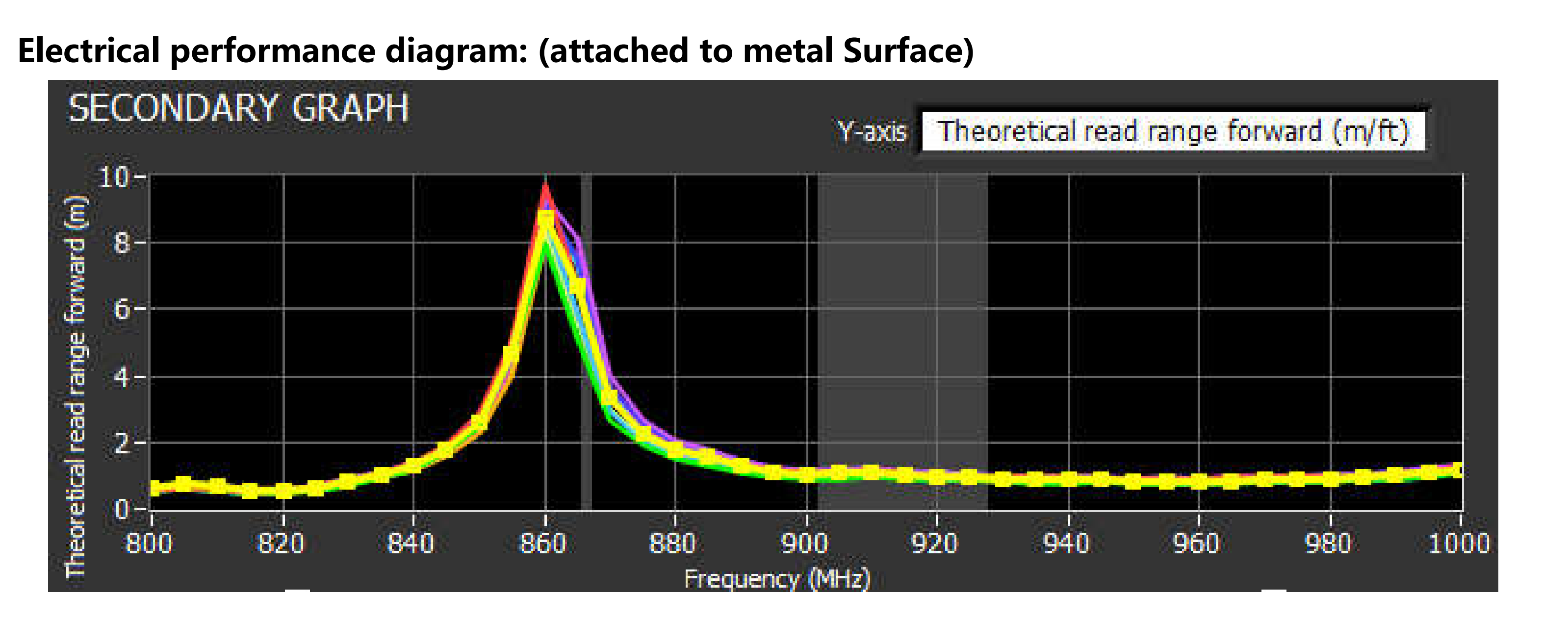
Figure: An ETSI-tuned flexible on-metal RFID label (60×25 mm) designed for 865–868 MHz. These labels are frequency-specific and won’t perform well in the 902–928 MHz bandfornextrfid.co.uk.
This also explains why some integrators see RFID read distance issues when traveling between regions. Even if the chip supports the EPC Gen2 protocol globally, the tag’s antenna must be designed for the local UHF band. If you try to use a US-tuned “902–928 MHz” on-metal RFID label in Europe, the detuned antenna can cut the read range by 50% or more (or stop responding entirely).
Why Band Mismatch Detunes the Antenna
RFID tags work by backscatter: the reader’s RF wave induces current in the tag’s antenna, which powers the chip and re-radiates a signal. The tag antenna must be matched to the carrier frequency for efficient energy transfer. UHF tag antennas are typically cut or printed for a narrow frequency band. Think of it like a radio tuned to one station – it doesn’t pick up others well. If the frequency shifts by tens of MHz, the tag’s impedance no longer matches, and the energy transfer efficiency plummets. In short, the tag is detuned.
When this happens, the tag still might get a bit of power, but its effective range drops drastically. In real terms, a US tag on an EU reader might only read at very short range (centimeters), if at all. Conversely, an ETSI-tuned tag on a US reader will suffer similarly. This is true even on open air; the antenna simply isn’t resonant. On top of that, metal surfaces make the problem worse. Metal interacts with RF waves and can shift the antenna resonance even further. In fact, generic UHF tags become detuned when placed on metal. Without special design, a tag stuck on metal will see its tuned frequency shift significantly.
On-metal RFID labels compensate for this by adding insulating layers (foam or plastic) under the antenna. These isolation layers keep the metal from directly touching the antenna, preventing the metal from detuning it. In practice, a quality on-metal label uses a foam spacer and a metal-backed foil to form part of the antenna. The design and material choice are carefully tuned for the target band. That’s why you’ll see product descriptions like “Optimised exclusively for 865–868 MHz (ETSI) band”.
Wideband “Global” UHF RFID Labels
Standart passive UHF RFID labels (for example, paper or PET “smart-labels”) often use broad-band antennas spanning roughly 860–960 MHz. These tags are frequently sold as global/dual-band EPC Gen2 labels because one inlay will work in both the US and EU bands without modification. In practice, a standard off-metal label tagged “global UHF” can be used in either FCC (902–928 MHz) or ETSI (865–868 MHz) regions. These wideband label designs tolerate frequency differences, so no separate versions are needed for each region. In short, most normal adhesive UHF tags are designed as broadband/global products.

Figure: A normal UHF off-metal RFID label (27*10 mm) designed for Global(860- 960 MHZ).
On-Metal RFID Tags – Narrowband Tuning
By contrast, on-metal UHF RFID tags (those with special backing or antenna structures for mounting on metal) are much more frequency-specific. An on-metal tag’s antenna is strongly influenced by the metal surface, so its design typically has a very narrow bandwidth. Most passive metal-mount tags on the market are tuned for a particular band. In fact, leading manufacturers offer separate FCC and ETSI versions of their on-metal labels. For example, HID Global’s “IQ On-Metal” UHF labels come in distinct FCC (US) or ETSI (EU) variants, and Avery Dennison’s flexible on-metal inlays are explicitly made in ETSI or FCC versions. In practice, you must choose the on-metal tag version that matches your region’s band. True “global” on-metal tags are rare – dual-band designs exist mainly in lab research, while commercially available metal-mount tags are almost always single-band. In short, using a US-tuned metal tag in Europe (or vice versa) will usually give very poor performance. ETSI RFID Standard FCC RFID Guidelines
Effects of Metal on Antenna Tuning
Metal surfaces dramatically affect UHF tag antennas. Physically, the metal causes the tag’s resonant frequency to shift and the antenna to become more sensitive. To achieve useful range on metal, designers often make the antenna high-Q (for example using ferrite or cavity-backed elements). But a high-Q antenna has inherently narrow bandwidth. In practical terms, an on-metal tag tuned to 865–868 MHz will be optimized only around that band; its efficiency at 902–928 MHz will drop off sharply. Conversely, a US-tuned metal tag reads poorly in the EU band. This means metal-mount tags must be carefully matched to their frequency. In mismatched cases, the read range on metal can collapse – much more so than it would for a wideband label in free space
Flexible On-Metal vs Hard Tags: Sensitivity
Flexible on-metal labels (adhesive stickers) differ from rigid “hard” tags. Rigid tags often have a plastic housing and a larger ground plane, which can broaden the effective bandwidth a little. Thin label-style tags are more sensitive to tuning errors. They rely on a thin PET/foam/foil stack and a precise antenna pattern, so even small mismatches or metal contact can affect them more. In practice, this means you must be extra careful with flexible labels: always use the exact band-tuned version. If you try to put an ETSI-tuned label on a US-frequency asset, you may see no reads. It’s a common real-world issue in RFID deployments.
Real Lab Test Results
We regularly test tags in the lab (e.g. using Voyantic Tagformance) to quantify these effects. For example, ForNext’s 60×25 mm ETSI label (Monza R6-P chip) was measured at ~5 m on-metal range in the 865–868 MHz band. The comparable 70×30 mm FCC-tuned label of similar construction measured about 8 m in the 902–928 MHz band. (These ranges assume a fixed reader antenna and maximum allowed power.) These results match expectations: the FCC band permits more power, and the tag is optimized for that band. ForNext provides documentation and test reports for all tags, so system integrators can see the actual performance. If you encounter unexpected read distance problems, it’s worth reviewing the lab specs and testing tags in your environment.
Tips for Choosing the Right RFID Tags
- Match the region: Always order tags labeled for your region’s band. FCC (902–928 MHz) tags won’t give good range in Europe, and ETSI (865–868 MHz) tags won’t work well in the US, especially for the on-metal tags.
- On-metal design: For metal surfaces, use on-metal RFID labels or tags. These are built with foam spacers and tuned antennas to handle metal. Don’t just slap a standard label on metal – it will detune badly.
- Check tag form factor: Rigid “hard” tags (plastic) are more rugged but often larger. Flexible labels stick on flat or curved metal but need the correct tuning. Decide based on durability and space. (Flexible labels can be printed on thermal printers like Zebra/SATO if needed.)
- Power and polarization: Ensure your reader is set to the matching band and polarization. Even with a proper tag, wrong reader settings will reduce range.
- Test samples: Before bulk ordering, test a few tags with your readers. Verify the read range and reliability on your actual metal surfaces. ForNext tests every tag batch in an anechoic lab, but real-world conditions vary.
By following these guidelines, integrators can avoid common RFID read distance issues. In summary: RFID tags are not one-size-fits-all globally. Frequency band, antenna tuning, and even tag form factor all matter. Make sure your UHF tag is compatible with the reader’s country regulations, especially when working with metal assets. Properly tuned on-metal tags will then deliver the reliable read range you expect.

