

A Technical Guide for UK/EU Industrial Asset Tracking
What Is an On-Metal RFID Tag? An on-metal RFID tag – sometimes called an anti-metal tag – is a specially engineered transponder designed to work reliably on metal surfaces. Unlike ordinary RFID labels, on-metal tags incorporate advanced materials and design features (such as insulating spacers, ferrite backing, or tuned antenna geometries) that overcome the interference caused by metal. In practice, an on-metal tag often has a thin ferrite/foam layer or spacer between the antenna and the metal, effectively isolating it so that the RF field is not shorted out or detuned by the metal. This allows the tag’s antenna to resonate correctly and reliably transmit data even when bonded directly to metallic equipment, tools, containers or panels.
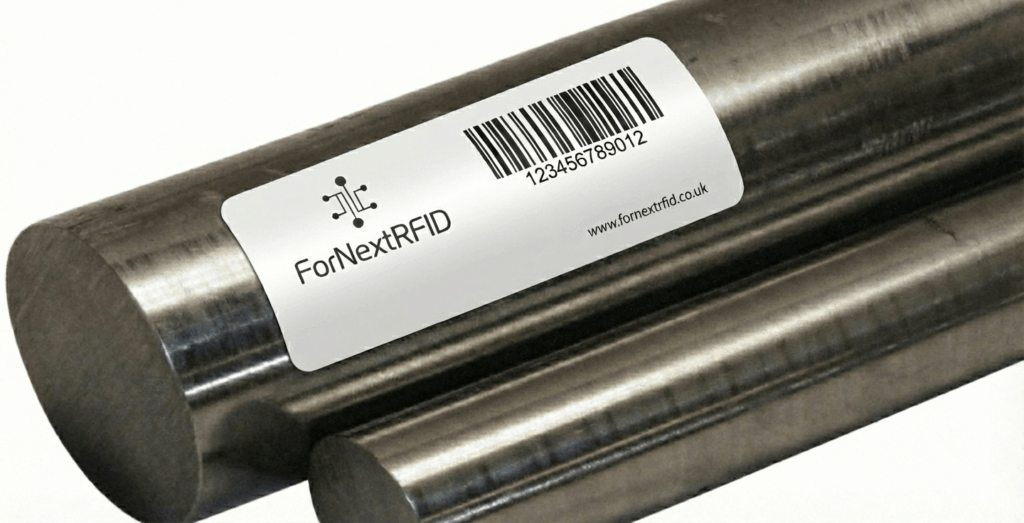
In short, an on-metal RFID tag is a purpose-built RFID label or hard tag that integrates a shielding/isolation layer (often ferrite or foam) and other rugged features. These tags are widely used in industrial asset tracking, IT equipment management, construction sites, and other sectors where assets or containers are made of metal. They are typically available in UHF (860–960 MHz, optimized for 865–868 MHz UK/EU band) and some HF (13.56 MHz) variants, and come in many form factors (labels, “coin” tags, capsules, etc.) to suit different applications.
Why Standard RFID Tags Don’t Work on Metal. Standard RFID tags fail on metal for fundamental electromagnetic reasons. Metal surfaces are highly conductive and reflect radio waves. When a reader’s RF signal hits metal, much of it is reflected or absorbed rather than reaching the tag. This creates multipath interference and “null zones” that distort or cancel the signal. Moreover, metal in close proximity induces eddy currents: circulating currents that drain RF energy and shift the tag’s antenna resonance (a phenomenon known as detuning). In practice this means that a tag stuck directly on metal often has its tuned frequency changed and its effective range dramatically reduced.
In other words, metal objects act like big, unwanted antenna elements: they reflect and absorb the reader’s field unpredictably and siphon energy away from the tag’s antenna. The result is that a standard RFID tag on metal usually has a very short read range or simply fails to communicate. As one source explains, placing a normal tag on metal “alters its resonant frequency” (detuning it) and causes the radio signal to be absorbed or reflected unpredictably, so communication “becomes unstable or completely interrupted”. Therefore, metal surfaces typically shorten reads and cause missed scans unless a tag is specifically designed for metal.
Types of On-Metal RFID Tag Constructions. On-metal RFID tags come in various constructions, each optimized for different trade-offs of flexibility, durability, range and cost. The most common types include:
- Flexible anti-metal labels. These look like a thin adhesive label or tag. Construction-wise, they are usually made from a printable polyester/PET or vinyl material laminated onto a foam/ferrite backing. A ferrite sheet or foam spacer is embedded under the chip’s antenna to isolate it from the metal. They are thin, lightweight and typically operate at UHF (860–960 MHz) – for example, a 30×15 mm polyester label with an Alien Higgs chip. Durability: Moderate – they resist everyday indoor conditions and light moisture, but have limited abrasion or chemical resistance (typically IPX4–IPX6 rated at best). Mounting: Strong pressure-sensitive adhesive (e.g. 3M tape) on a flat, clean metal surface. Use cases: Asset or inventory labels on metal shelving, IT racks, cable drums and other fixed equipment; tool tagging on handles or metal toolboxes; returnable transit item (RTI) tracking for metal bins. Strengths vs Trade-offs: Very low-cost and printable (barcodes, logos, serials can be thermal-printed on the label), with decent read range (several metres). However, they are not very rugged – they can peel off, tear, or fail in harsh conditions, and typically have limited temperature and weather tolerance.
- Epoxy/acrylic dome tags. These small rigid tags have the RFID electronics encapsulated in a rounded epoxy or acrylic resin dome (often on a plastic or glass-fiber substrate). For example, one compact design uses a PVC/epoxy housing with a glass-fiber board, available in 10–17 mm round sizes. Durability: High – most are rated IP67 and can tolerate wet, dust and moderately high temperatures (many operate up to +85 °C. They offer better impact resistance than flat labels (the hard dome protects the antenna). Mounting: Usually adhesive on a flat metal surface (a pressure-sensitive backing). Small screw-hole versions also exist for panel mounting. Use cases: General industrial tagging on metal objects: equipment panels, metal cabinets, conveyors, or on metal components that need a small tag. They are often used where a printable or visible label isn’t needed or where a bit more ruggedness is desired. Strengths vs Trade-offs: Tougher than flexible labels and can be brightly colored or custom-shaped, yet still relatively low-cost. They typically have shorter range than larger hard tags and, being small, can be lost if dislodged.
- PCB-based rigid tags. These are hard tags built on a standard FR-4 circuit-board with tuned antenna tracesg. The PCB may be coated or potted for protection. Durability: Very rugged. Many are IP67/68 rated and can operate in extremes (e.g. −40 °C to +100 °C). Mounting: They usually have mounting holes or slots, so they can be screwed or riveted onto metal (or in some cases glued with strong epoxy). For example, a GAO industrial metal-mount tag has two 3 mm holes for screws. Frequencies: Mostly UHF (EPC Gen2). Use cases: Industrial asset tagging where robustness and range are needed – for instance, tracking heavy machinery, IT servers, or automotive parts. One IP68-rated PCB tag boasts up to ~7 m read range on metal with a fixed reader, making it suitable for long-range scanning. Strengths vs Trade-offs: Excellent environmental resistance (waterproof, wide temp, vibration-proof) and long read range. They are typically thicker and heavier, and more expensive. These tags generally aren’t printable (identification is done via laser etching or engraving on the casing).
- ABS plastic hard tags. These are durable plastic housings (commonly ABS or polycarbonate) with an embedded RFID inlay or chip. They look like rugged key fobs, discs, or rectangular tags. Durability: Very rugged – typically IP65 or IP67, good impact and chemical resistance. Mounting: Designed for permanent fixing – most have built-in screw or rivet holes, or can use industrial-strength adhesive. For example, one source notes that hard plastic metal-mount tags “can be attached onto metal assets with rivets, screws, epoxy, embedded, zip ties, or even extra strength adhesives”. Frequencies: Usually UHF (some HF versions exist). Use cases: Outdoor assets, vehicles, manufacturing equipment, pallets/containers, returnable racks – essentially any heavy-duty application. Strengths vs Trade-offs: Very durable and weatherproof, with good read range. Bulkier and more costly than labels. They are not printable, so markings must be molded in or laser-engraved.
- Ceramic tags. These are small, rigid tags where the chip/antenna is encased in a high-grade ceramic material. Construction: Typically a thin disc or plate (for example, 25×9×3 mm) of alumina ceramic with a bonded antenna and chip. Durability: Extremely high. Ceramic tolerates high heat, cold and chemicals. Many ceramic tags are IP65 or higher and are used in ovens or autoclaves. (One example: a 25×9×3mm ceramic UHF tag rated IP65, operating from –50 °C to +85 °C.) Mounting: Often adhesive-backed (e.g. 3M 300LSE tape) for sticking on metal, or embedded into metal parts or composite with epoxy. Frequencies: Usually UHF, though HF/NFC metal-safe ceramic tags also exist for specific applications. Use cases: Extreme environments – aerospace (engine parts), oil & gas (downhole tools), automotive (engine bay parts), industrial laundry (washable tags), semiconductor or medical instrumentation. Strengths vs Trade-offs: Very small and rugged, great for high-temp/chemical exposure, with decent read range given their size. They are typically more expensive per unit and the small size limits memory/range somewhat compared to larger tags.
- Stainless steel–encapsulated industrial tags. These are ultra-rugged tags housed in a solid stainless-steel shell (often cylindrical or disc-shaped), sometimes filled with epoxy around the electronics. Durability: The highest level – typically IP68, and tolerating very high temperatures and harsh abuse. For example, a rugged M8×25 mm stainless-steel RFID tag is rated for up to 250 °C and IP68. It will survive vibration, welding, salt fog, and chemical exposure. Mounting: Permanently fixed – usually via a screw or bolt (often with a threaded stud) or even welded directly to the metal asset. Frequencies: UHF (Gen2) primarily. Use cases: Heavy industry – oil & gas valves and pipelines, construction steelwork, military equipment, chemical plants – anywhere tags must endure extreme heat, pressure, or corrosives. Also used for tamper-evident tagging where removal is not intended. Strengths vs Trade-offs: Exceptionally durable and tamper-proof. However, they are relatively large and heavy for the number of memory bits, and they are the most expensive tags. Custom stamping/laser-etching on the steel provides non-removable IDs or barcodes.
Comparison of Common On-Metal RFID Tag Types and Use Cases
| Tag Type | Construction & Material | Durability | Mounting Method | Typical Frequency | Use Cases | Strengths | Trade-Offs |
|---|---|---|---|---|---|---|---|
| Flexible Anti-Metal Label | PET/vinyl label on foam or ferrite backing | Moderate (IPX4–IPX6) | Adhesive (3M) on clean metal | UHF | Metal shelves, IT racks, RTIs, tools | Low cost, printable, decent read range | Not rugged, limited temp/weather tolerance |
| Epoxy/Acrylic Dome Tag | Epoxy or acrylic dome on PVC/fibreglass | High (IP67, shock-resistant) | Adhesive or screw-on | UHF | Industrial panels, cabinets, conveyors | Tougher, visible/compact, IP-rated | Shorter range, can detach, not printable |
| PCB-Based Rigid Tag | FR-4 PCB with tuned antenna | Very High (IP67/68, −40°C to +100°C) | Screw, rivet, epoxy | UHF | Machinery, automotive, servers | Rugged, waterproof, long read range | Bulkier, more expensive, not printable |
| ABS Plastic Hard Tag | ABS/polycarbonate housing | Very High (IP65/67, impact/chemicals) | Screw, rivet, zip tie, adhesive | UHF (some HF variants) | Outdoor assets, pallets, containers | Durable, multi-mount, weatherproof | Not printable, more costly than labels |
| Ceramic Tag | Alumina ceramic with embedded chip | Extreme (IP65+, −50°C to +85°C) | Adhesive or embedded | UHF (some HF/NFC) | Aerospace, oil & gas, medical, laundry | Compact, heat/chemical proof | High cost, limited range/memory due to small size |
| Stainless Steel Encapsulated | Steel shell with epoxy fill and chip | Maximum (IP68, 250°C+ tolerance) | Screw, bolt, weld | UHF | Oil/gas, military, pipelines, extreme environments | Ultra-durable, tamper-proof | Large, expensive, heavy for bit capacity |
Each tag type has strengths and trade-offs. Flexible labels are cheap and printable but less rugged. Hard plastic or steel tags are heavy-duty but bulkier and costly. Ceramic tags excel in heat/chemical but are small. Epoxy tags strike a middle ground of cost vs ruggedness. When selecting a tag, consider the factors below to match tag type to the application.
Choosing the Right On-Metal RFID Tag: A Practical Guide
To pick the optimal on-metal RFID tag for a UK/EU industrial application, evaluate the following factors:
- Environment: Consider temperature, moisture, chemicals, and other hazards. If the tag will see extreme heat or cold, choose high-temp tags (e.g. ceramic or stainless models rated for those ranges). For outdoors or wash-down conditions, use fully waterproof (IP68) tags and weatherproof materials (stainless steel or sealed plastics). In corrosive or chemical environments, select corrosion-resistant housings. For example, in oil & gas or chemical plants, tags often need to resist solvents and high heat simultaneously.
- Surface: Flat, smooth metal is ideal for adhesive labels or flat tags (ensure surface is cleaned beforehand). Curved or cylindrical objects (pipes, cables, tools) may require cable-tie/band tags or “flag” style tags that extend off the metal. Very rough or painted surfaces may reduce adhesive bond, so consider mechanical mounting (screws, rivets, welds) or special primers. On-pipe tags (band-on tags) are designed to wrap around cylindrical workpieces. Always mount labels on clean, dry, and even surfaces to get the stated performance.
- Size and Read Range: Bigger tags generally have longer read range. If a large read distance is needed (for example scanning from a distance in a warehouse), use a larger hard tag (ABS or metal casing). For short-range applications (close-proximity scanning), even small tags or labels suffice. Also consider space constraints: if embedding a tag inside a metal part, a thin flexible tag or small ceramic tag may be required. The guide notes that thicker tags can provide stronger anti-interference capability, whereas thinner tags fit constrained space.
- Mounting Method: If the tag must not move or be removed, use screw/rivet or weld mounting. Many industrial tags have holes or studs for permanent fixing. Otherwise, heavy-duty adhesives (like 3M VHB) or epoxy are common. For example, one source recommends screw/rivet attachments for heavy machinery and high-vibration areas, and epoxy for high-temp or corrosive settings. Cable ties or zip-tie tags are convenient for temporary or tracking purposes on large items.
- Tamper-Resistance: If tampering is a concern, choose tags that break if removed or leave evidence (e.g. labels that void when peeled) or simply use welded/screwed tags. Stainless-steel tags or welded discs are extremely hard to remove without destroying them. Some tags allow tamper-evident features like break-away rivets or custom engraving for added security.
- Data & Branding: For visual identification, note that flexible labels and epoxy tags can be printed (barcodes, logos, serial numbers) before deployment. Hard plastic or metal tags usually rely on laser engraving of text/serial numbers. If your asset-tracking requires human-readable IDs alongside RFID (as in many UK IT-asset or aerospace applications), select a tag that supports engraving or printing. Some manufacturers offer custom printing or laser marking services for batch-encoded tags.
- UK/EU Regulatory Compliance: Use tags tuned for the UK/EU UHF band (865–868 MHz) and certified for CE/UKCA compliance, RoHS and REACH directives. Many on-metal tags sold in the UK are already on UKAS-accredited catalogs, but always check frequency, power limits and material safety standards (especially for recycled or plastics). In Europe, tags used in explosion-risk areas must also meet ATEX certification if used on oil rigs or chemical plants.
By weighing these factors – environmental conditions, surface geometry, required read range, mounting permanence, and regulatory needs – you can select the most suitable on-metal RFID tag. As one industry guide notes, choosing tags that match the application. For example, a data center with metal racks might use printed anti-metal labels for easy ID, whereas a blast furnace workshop would use welded stainless tags rated for heat. In the end, the right on-metal tag is one whose form factor, materials and attachment method fit the asset and its environment.
Final Thoughts
On-metal RFID tags are a vital enabling technology for robust RFID metal asset tracking industries – from manufacturing and logistics to IT and oil & gas. By understanding the physics of metal interference (reflection, eddy currents, detuning) and the special constructions (ferrite-backed labels, resin-encapsulated tags, PCB-based modules, ceramic discs, steel housings), system integrators can deploy reliable RFID on any metallic object. Always match the tag type to the use-case: for instance, use flexible polyester anti-metal RFID labels for high-volume IT asset management, or choose rugged stainless-steel tags for critical outdoor plant tracking. Selecting the proper on-metal tag – considering environment, surface, range, and mounting – is crucial.
By following these guidelines and using tags rated for UK/EU or US conditions (865–868 MHz/902-928 MHZ relevant IP and material standards), you can achieve reliable long-term tracking of metal assets without vendor promotion or hype.

