

Fast-growing manufacturers often invest heavily in sales, product development and production lines – but the warehouse quietly becomes a bottleneck. Manual counting, Excel-based stock checks and “tribal knowledge” about where items are stored eventually break under the pressure of more SKUs and higher order volumes.
This article uses an anonymised case study of a mid-sized electronics manufacturer (“Company A”) to show, in practical terms, how RFID-enabled warehouse inventory management can transform accuracy and efficiency – without naming any specific WMS or ERP vendors.
We’ll focus on what RFID actually changed in the warehouse, and what other manufacturers can learn from it.
Background: When Growth Exposes the Warehouse Gap
Company A is a fast-growing electronics equipment manufacturer with annual revenues in the hundreds of millions of RMB. Like many maturing manufacturers, it was proud of its product quality and fast response to customer demand – but warehouse operations were lagging behind.
Three core pain points kept appearing:
- Inbound: slow, manual and disconnected from ERP
- Goods arrived with paper delivery notes.
- Warehouse staff manually counted items, wrote everything down, then later re-keyed data into the ERP in the office.
- This process could take hours, so ERP stock levels were always behind reality.
- Production planning teams often found “available on paper, missing in reality” material shortages at the worst possible time.
- Picking: dependent on “heroes” and prone to error
- Picking was entirely based on memory and experience.
- A few senior warehouse operators knew thousands of locations by heart; when they were off or left, performance dropped sharply.
- Mis-picks and short shipments caused line stops and occasional customer complaints.
- Stocktaking: painful, costly and never fully accurate
- Once a month, the warehouse shut down for a full physical count.
- All staff worked overtime, production was disrupted and yet the books still didn’t match reality.
- Finance and operations spent days reconciling differences.
Management realised that simply adding headcount would not solve the problem. They needed:
- Real-time inventory visibility, not next-day updates.
- Tighter integration between ERP and warehouse processes.
- A way to count and validate stock with minimal manual effort.
Solution Overview: RFID-Enabled WMS Integrated with ERP
Rather than replacing their ERP, Company A chose to layer a warehouse management solution tightly integrated with the existing ERP, and to use UHF RFID as the key enabler in the physical warehouse.
The design principles were:
- Single source of truth – ERP remains the financial and planning backbone; warehouse operations push real-time, trusted data back into it. Lowry Solutions+1
- Process-first, not software-first – rethink receiving, put-away, picking and counting before customising systems.
- RFID where it adds clear value – high-throughput areas and repetitive scanning tasks, not “RFID everywhere”.
Architecture in simple terms
- ERP system – continues to handle purchasing, sales orders, MRP and finance.
- Warehouse system (WMS module or equivalent) – manages tasks, locations, and execution (inbound, put-away, picking, stock counts).
- API-based integration – instead of file imports/exports, real-time interfaces synchronise master data and key transactions.
- RFID infrastructure:
- UHF RFID labels on cartons, bins or pallets.
- RFID tags on rack locations and staging areas.
- Handheld RFID readers and some vehicle-mounted units for fast scanning.
This sort of integrated approach is increasingly common: RFID is used to feed real-time data into WMS/ERP, improving inventory accuracy, reducing labour and speeding up stocktaking and picking.
Inbound with RFID: From Manual Counting to One-Scan Receiving
Old process
- Goods arrive with a paper delivery note.
- Operator manually counts each line item.
- Quantities are written on paper.
- Later, someone re-enters data into the ERP.
- Mistakes and delays are common; put-away locations are chosen ad hoc.

New RFID-enabled process
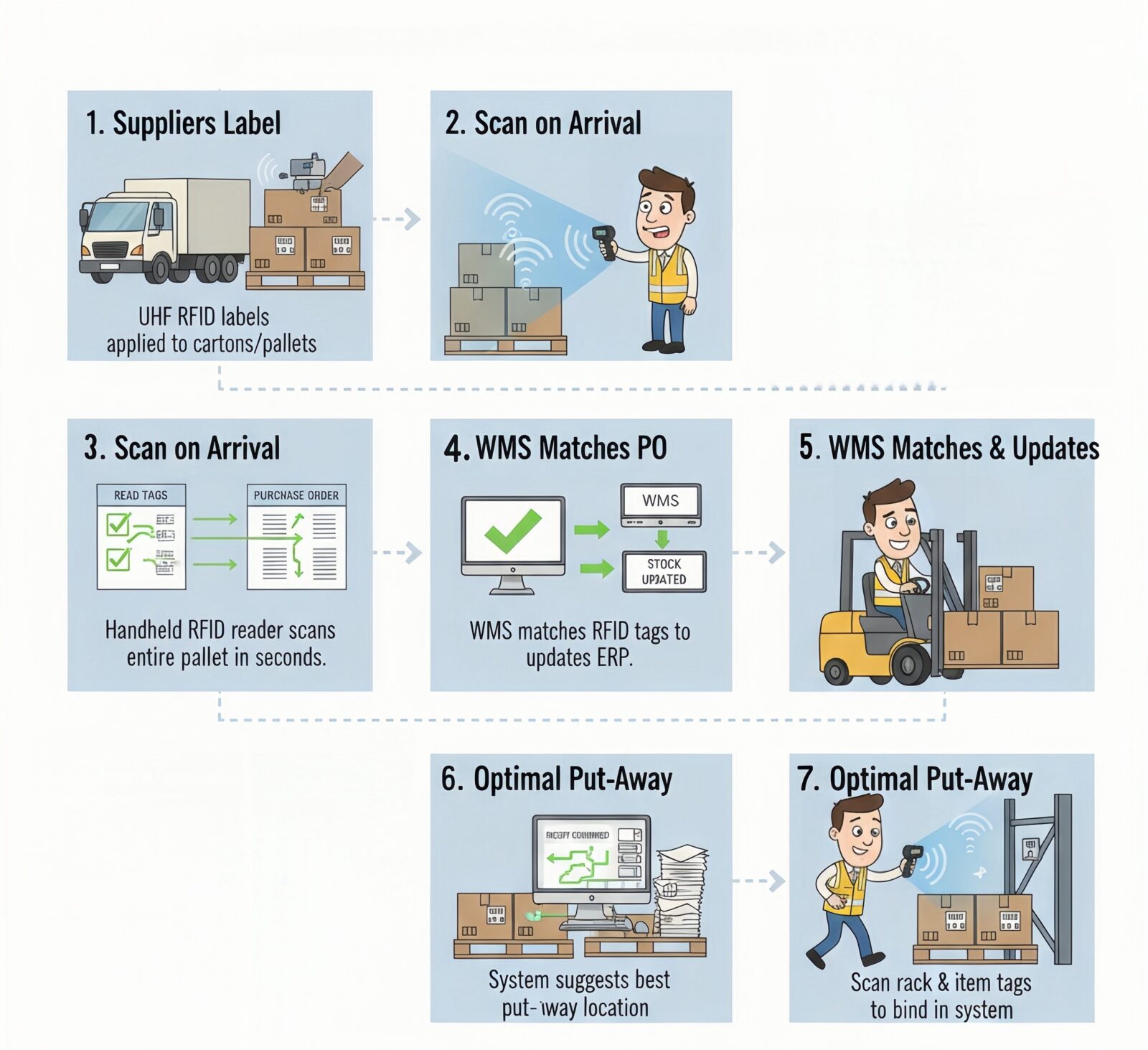
- Suppliers apply UHF RFID labels to outer cartons or pallets according to a simple labelling specification.
- On arrival at the dock, the operator uses a handheld RFID reader to scan the entire pallet or batch in seconds.
- The WMS automatically matches the read tags to the purchase order lines received from the ERP.
- If quantities and item numbers align, the system:
- Confirms receipt in the WMS, and
- Sends a confirmation back to the ERP to update stock and create the inbound transaction.
- The WMS then suggests optimal put-away locations based on rules (ABC classification, weight/size constraints, consolidation with existing stock).
- On put-away, the operator:
- Drives to the suggested rack location,
- Scans the rack’s RFID location tag, and
- Scans the pallet/carton tag once more to bind item and location in the system.
What changed in practice
- Count times dropped dramatically – from minutes per pallet to seconds.
- Manual data entry disappeared; the system writes directly into ERP and WMS.
- Misreceipts were caught at the dock instead of weeks later during stocktake.
In Company A’s project, receiving productivity improved by more than 60% and upstream production planning finally started to trust inbound inventory data.
Picking with RFID: From Tribal Knowledge to Guided, Verifiable Work
Once inbound and storage locations were reliable, the focus moved to picking.
Old picking model
- The warehouse printed a picking list.
- An experienced operator walked the warehouse, finding items from memory.
- There was no system validation at the point of pick: as long as something was taken and marked as done, it was assumed correct.
- New staff took months to become productive; errors were difficult to trace.
New RF/RFID-guided picking
- The WMS generates system tasks based on sales or production orders imported from ERP.
- Tasks are grouped into waves to optimise walking paths and workload.
- Pickers log into mobile terminals which show:
- The next location to visit,
- The item and quantity required,
- The suggested route.
- At each location, the picker:
- Locates the rack by visual label and/or rack light,
- Uses the RFID handheld to confirm the location tag,
- Reads the item tags in the bin or on the pallet, and
- The system checks: “Is this the correct SKU and quantity?” in real time.
- Only when system verification passes does the task move to “picked” and downstream processes (packing, shipping, or line feed) are triggered.
Outcomes
- New staff could reach standard productivity quickly, because the system told them where to go and what to pick.
- Mis-picks and short picks dropped sharply because every pick was validated at source.
- Senior “hero” pickers were no longer a single point of failure.
In Company A’s case, average order processing time reduced by roughly one-third, and capacity in the same warehouse footprint increased by about 50%.
Inventory Accuracy with RFID: From Monthly Pain to Daily “Self-Healing”
Previously, the only way to regain control was a full physical stocktake:
- The warehouse stopped normal operations.
- All staff counted every location.
- Data was keyed into spreadsheets or ERP.
- Differences were investigated and adjusted.
With RFID, the company shifted to continuous cycle counting:
- The WMS generates daily or weekly cycle-count tasks based on:
- ABC classification (high-value or fast-moving items more frequently),
- Locations with recent discrepancies, or
- Random sampling.
- A cycle counter walks the assigned zone with an RFID handheld:
- Reading all tags on shelves and pallets as they pass,
- The system compares reads to expected stock.
- Any variances are flagged instantly for investigation:
- Misplaced items,
- Wrong quantity on a pallet,
- Ghost stock that exists in the system but not in reality.
Because counts are fast – RFID can read tens or hundreds of tags in a fraction of a second and without line-of-sight – the warehouse can cover large areas during normal shifts.
In the project we’re describing, inventory accuracy reached around 99.9%, and the phrase “daily clear, daily settled” became realistic: the system self-corrected via continuous micro-counts instead of monthly “big bang” stocktakes. Similar accuracy levels (98–99.9%) are also reported in independent RFID warehouse and supply chain case studies.
Before and After: KPI Snapshot
Below is a simplified view of the impact Company A recorded after roughly three months of operation:
| Area | Before RFID & WMS integration | After RFID-enabled processes |
|---|---|---|
| Inbound receiving time | Slow; manual counting and ERP keying; hours | 60%+ faster; scan-and-confirm, automatic posting |
| Inventory accuracy | Frequent gaps between book and physical | ~99.9% accuracy with continuous cycle counting |
| Picking performance | Dependent on senior staff; high mis-pick risk | System-guided; verifiable picks; fewer errors |
| Monthly stocktake | Full-day shutdown + overtime | Replaced by rolling cycle counts |
| Warehouse labour cost | High level of manual handling and rework | ~30% reduction through automation and fewer errors |
| Trust in ERP data | Low – planning teams double-check everything | High – ERP reflects near real-time stock |
Numbers will of course vary by site, but this pattern aligns well with broader market experience where RFID is used to feed real-time inventory data into WMS and ERP.
What RFID Actually Adds Beyond a Traditional WMS
It’s important to be clear: a WMS alone does not guarantee accurate stock. Without good data capture at the edge, even the best software becomes an expensive database of bad information.
RFID adds three distinctive capabilities on top of barcodes and manual entry:
- Fast, non-line-of-sight data capture
- Multiple items can be read simultaneously, without needing to aim a scanner at each barcode.
- Real-time visibility
- Goods movements (receiving, put-away, moves, picks, counts) are captured automatically and pushed straight into WMS/ERP.
- Lower dependence on individuals
- Processes become system-driven rather than memory-driven; handhelds and workflows tell staff what to do and validate actions in real time.
Industry studies show that when RFID is tightly integrated with WMS, companies can significantly improve picking speed, increase space utilisation and reduce labour costs – particularly in high-mix, high-volume environments.
Implementation Lessons for Manufacturers
From this project (and many others like it), several practical lessons stand out for manufacturing warehouses:
- Start with master data and integration
- Clean up SKU codes, units of measure, and location structures in ERP.
- Decide which system “owns” which data, then build robust APIs rather than relying on imports/exports.
- Map processes, then add RFID where it counts most
- Don’t just copy old paper workflows into a new system.
- Target high-impact processes first: inbound, put-away, picking, stock counting.
- Design your tagging strategy carefully
- Outer cartons, returnable containers, pallets and rack locations may all need different tag types.
- For example:
- Logistics labels for cartons and cases,
- On-metal UHF tags for steel racks and trolleys,
- Durable tags for reusable bins and returnable packaging.
- Pilot, measure, then scale
- Start with one warehouse zone or product family.
- Measure inventory accuracy, throughput and error rates before and after.
- Use real data to justify wider rollout.
- Work with specialist partners
- System integrators handle WMS/ERP and process design.
- RFID specialists and tag manufacturers support tag selection, antenna positioning and on-site testing.
How ForNext RFID Can Support Similar Projects
ForNext RFID focuses on the tag and label layer that underpins projects like this. While software and integration are handled by your WMS/ERP integrator, the choice of tags has a huge impact on read reliability and long-term running costs.
Examples of ForNext product types that typically appear in RFID-enabled manufacturing warehouses include:
- UHF logistics and warehouse labels for cartons, cases and pallets – printable, with embedded RFID inlays
- e.g.
ForNext UHF Logistics LabelsLogistics & Packaging
- e.g.
- On-metal RFID labels for steel racks, trolleys, fixtures and tools
- e.g.
ForNext On-Metal Labels→ On-metal RFID Label
- e.g.
- Durable RFID tags for returnable transit items (RTIs) such as bins, trays or kitting trolleys
ForNext typically works with:
- System integrators who design and implement WMS/ERP projects,
- Label and print partners who need consistent, industrial-grade RFID consumables, and
- Mid-to-large manufacturers who want predictable performance across European warehouses and plants.
If you’re planning an RFID warehouse inventory management project, the key is to treat RFID not as a gadget, but as an enabler of better processes and more reliable data. This anonymised case from Company A shows that, when combined with solid integration and process redesign, RFID can turn warehouse inventory from a constant headache into a stable foundation for growth.

