

Cold chain logistics underpins the safe movement of vaccines, pharmaceuticals, biologics and perishable foods. A single temperature excursion of just a couple of hours can destroy an entire shipment, trigger regulatory investigations and damage hard-earned customer trust.
At the same time, supply chains are getting more complex: more handovers, more 3PL partners, more last-mile scenarios. Traditional data loggers and basic RFID tags struggle to provide continuous, item-level visibility from production through to the point of use.
Dual-frequency RFID temperature sensor labels — combining long-range UHF (RAIN RFID) with NFC smartphone access — are emerging as a practical way to close these gaps. In this article, we’ll look at how they work, where they add value, and how ForNext’s UHF & NFC Dual Frequency RFID Temperature Sensor Logger can be integrated into real-world cold chain workflows.
Why cold chain logistics still fails
Even in mature markets like the UK and EU, cold chain breakdowns are still common:
- Tight temperature windows: vaccines, biologics and many modern medicines must stay within narrow temperature bands throughout storage and transport.
- Complex journeys: goods pass through manufacturers, wholesalers, 3PLs, airports, regional depots and last-mile carriers. Every handover creates risk.
- Manual processes: clipboards, spreadsheets and stand-alone USB data loggers make it hard to maintain a complete, tamper-resistant record.
- Regulatory pressure: Good Distribution Practice (GDP) requires continuous monitoring, calibrated equipment and robust documentation to prove that medicines stayed within specified ranges.
Traditional solutions have limitations:
- Single-use USB loggers find more https://cold-chain.co.uk/products/cold-chain-go/
- Often installed only at pallet or container level, not per box.
- Require manual downloading at the end of the journey — so issues are spotted late.
- Conventional RFID tags (UHF or HF only)
- Excellent for identification and inventory, but don’t log temperature histories.
- Single-frequency designs can’t cover both long-range scanning and smartphone access.
What’s missing is a way to combine continuous temperature logging with high-volume RFID reading and on-the-spot verification at the carton or parcel level. That’s exactly the problem dual-frequency RFID temperature labels are designed to solve.
What is a dual-frequency RFID temperature sensor label?
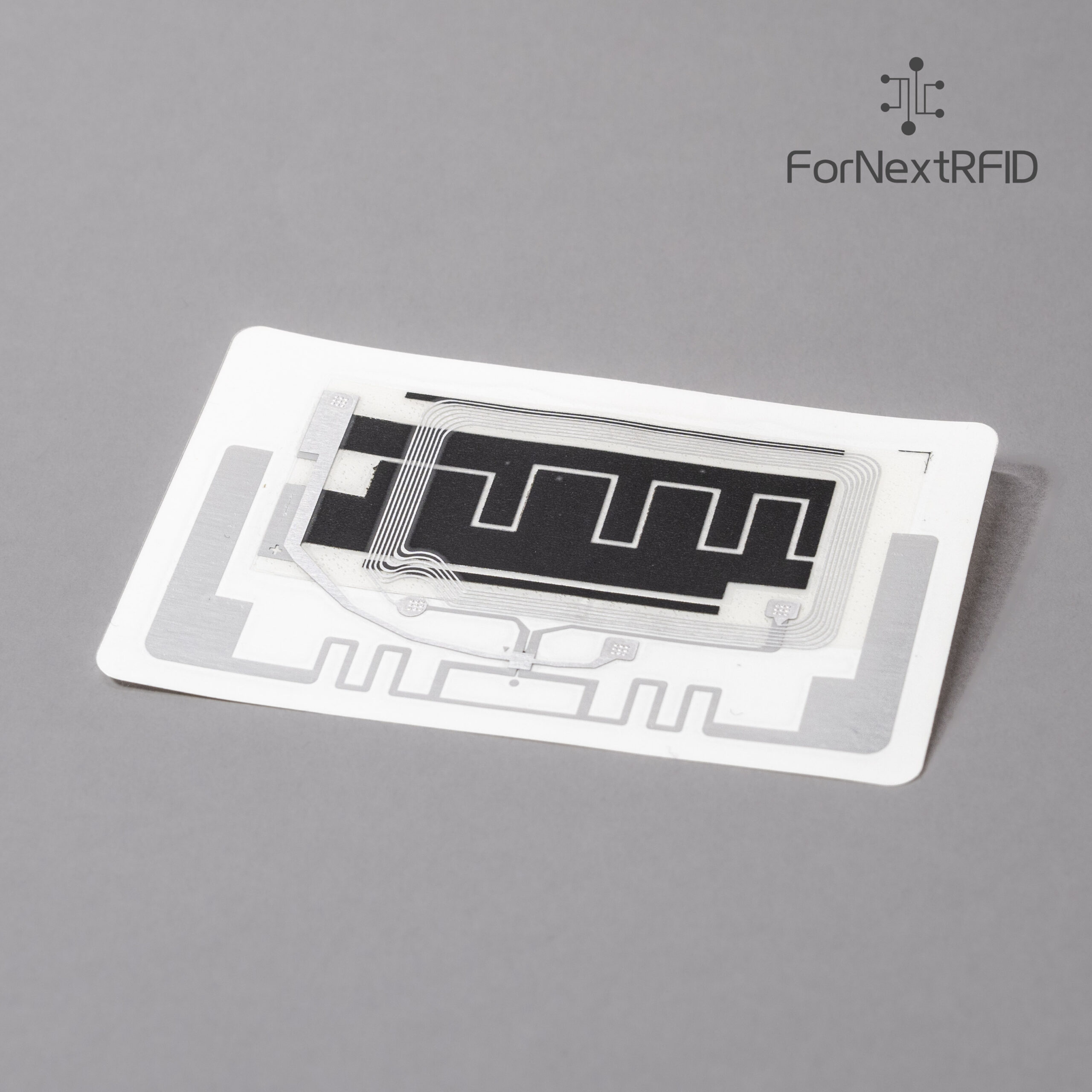
A dual-frequency RFID temperature sensor label integrates several functions into one ultra-thin form factor:
- UHF (RAIN RFID) interface – for long-range, bulk reading at dock doors, conveyors and portals.
- NFC interface – for close-range interaction with standard NFC-enabled smartphones or tablets.
- Onboard temperature sensor & memory – to log temperature over time and store thousands of records.
- Integrated battery (semi-passive) – to power temperature measurements even when no reader is nearby.
Compared with passive RFID tags, a semi-passive logger doesn’t transmit continuously. Instead, the battery powers the sensor and real-time clock, so the label can:
- Sample temperature at defined intervals (e.g. every 5–10 minutes).
- Store up to several thousand or tens of thousands of readings in memory.
- Make this log available when a UHF reader or NFC phone interrogates the chip.
This means the label “travels with the product” and provides a full record of conditions across the entire cold chain, not just at fixed monitoring points.
Key cold chain challenges solved
Cold chain logistics challenges: visibility and control at scale
In day-to-day operations, technical teams face a few recurring pain points:
- Maintaining temperature from production to last-mile delivery, across mixed fleets and multiple handling points
- Identifying where an excursion occurred — which site, which route, which vehicle.
- Linking temperature data with specific items or batches for recalls and investigations.
A dual-frequency RFID temperature label is applied directly to each box, tray or intelligent parcel. Every scan — at a warehouse gate, on a conveyor, or at a hospital pharmacy — updates inventory status and retains the temperature history in the same device.
Dual-frequency technology: precise monitoring end to end
Dual-frequency (UHF + NFC) brings two complementary capabilities into one tag:
- UHF (860–960 MHz)
- Long-range read (often several metres)
- Fast, bulk reading of many labels at once
- Ideal for portals, conveyors and pallet checks in busy depots
- NFC (13.56 MHz)
- Short-range, item-level access
- Use existing Android/iOS smartphones to read data logs
- Perfect for drivers, pharmacists, nurses and lab staff without specialised RFID readers
Because both interfaces share the same memory, any authorised device — a fixed UHF reader, a handheld, or a smartphone — can access the same temperature history.
Built-in battery & offline monitoring
In many routes, there are long stretches with no fixed infrastructure: road legs between depots, air freight segments, or time spent in storage at third-party sites.
Here, the integrated battery becomes critical:
- The label continues logging according to preset intervals, even when no reader is present.
- Data is stored locally in the chip until it is read at the next checkpoint.
- This protects against “blind spots” where traditional probes or fixed sensors are not installed.
For example, ForNext’s UHF & NFC Dual Frequency RFID Temperature Sensor Logger operates from –30°C to +50°C, with ±0.5°C accuracy, a 1.5 V / 10 mAh battery and up to 20,000 temperature logs in a label only 0.7 mm thick.
Data upload & automatic reports
Once a tag reaches a checkpoint or destination, operators can:
- Read the current status and full temperature profile via a UHF reader or NFC phone.
- Push the data into a cloud platform or on-premise system for visualisation and long-term storage.
From there, standard tools (or custom dashboards) can:
- Generate automatic PDF or electronic reports for each shipment or batch.
- Trigger alerts or workflows when thresholds were breached (or came close).
- Feed data into WMS, ERP, LIMS or quality systems to support GDP and HACCP documentation.
Enhanced efficiency & reduced manual intervention
Automated logging and RFID reading offer clear operational advantages:
- No need for manual clipboard entries or one-off USB downloads.
- Faster inbound and outbound checks — pass through a UHF gate rather than scanning each box manually.
- Lower labour input and reduced chance of transcription errors.
Over time, this leads to a more robust dataset that logistics, quality and regulatory teams can all rely on.
Minimized risks & ensuring customer trust
For sensitive healthcare and food applications, the ultimate goal is to prove that products have stayed within safe limits:
- Continuous logs show exact temperature histories across every stage of the journey.
- Clear evidence supports GDP inspections, customer audits and incident investigations.
- Being able to show that “this batch remained in range” reinforces customer confidence and protects brand reputation.
From raw data to decisions: readers, smartphones and the cloud
A dual-frequency RFID temperature logging solution typically involves three layers:
- Sensor labels – applied to each box, tray, container or asset.
- Reader infrastructure – fixed UHF portals at critical points, handheld readers for exception handling, and NFC smartphones for field staff.
- Software platform – which consolidates and analyses data.
Data flow might look like this:
- Configuration – tags are initialised before dispatch with logging interval, upper/lower limits, start time and journey ID.
- In-transit logging – labels sample temperature autonomously; fixed or handheld readers perform occasional “touch points”.
- Arrival & upload – upon delivery, a UHF reader or NFC phone uploads the full log to the platform.
- Analysis & reporting – the system checks for excursions, generates reports and, if needed, flags product for quarantine or investigation.
Because NFC is standard on most modern smartphones, it’s straightforward to extend monitoring out to drivers, couriers and clinicians without new hardware investments.
Real-world application scenarios
Dual-frequency RFID temperature labels are well-suited to several B2B use cases:
- Healthcare & pharmaceuticals
- Vaccine distribution, including mixed ambient/2–8°C/frozen chains.
- Hospital pharmacy stock moving between wards and satellite stores.
- Clinical trial kits requiring strict traceability and documented stability.
- Food & beverage
- Chilled and frozen foods across multi-drop routes.
- High-value ingredients for central production kitchens.
- Retail distribution centres validating supplier performance.
- Parcel & 3PL logistics
- Intelligent parcels containing samples, reagents or biologics.
- High-value, temperature-sensitive e-commerce products.
- Industrial & laboratory
- Specialty chemicals requiring controlled temperature.
- Research materials or reagents with strict handling conditions.
In each case, the dual-frequency label connects operational workflows (picking, packing, dispatch) with quality and regulatory workflows (release, deviation, recall management).
Spotlight on ForNext’s UHF & NFC Dual Frequency RFID Temperature Sensor Logger
ForNext’s UHF & NFC Dual Frequency RFID Temperature Sensor Logger | Cold Chain Monitoring | –30°C to +50°C is built specifically for these cold chain applications.
Key technical highlights
- Dual interface: UHF + NFC
- Temperature range: –30°C to +50°C
- Accuracy: ±0.5°C
- Battery: 1.5 V / 10 mAh, ~6-month design life (customisable)
- Capacity: up to 20,000 logged readings
- Form factor: ultra-thin label, ~0.7 mm thick
- Data: offline chip storage with optional cloud upload
- Reading methods: UHF fixed reader, handheld reader, NFC smartphone
This combination makes it suitable both for high-volume warehouse environments and for field staff who only have a mobile phone.
How it compares in practice
| Feature / Aspect | USB Data Logger | Single-Frequency RFID Temp Tag | ForNext Dual-Frequency Temp Logger |
|---|---|---|---|
| Identification & tracking | Per device only | Item-level via RFID | Item-level via UHF + NFC |
| Temperature logging | Yes, but local download only | Yes, but usually UHF or HF only | Yes, with dual-interface access |
| Read infrastructure | USB connection at end of journey | UHF or HF/NFC readers | UHF portals + NFC smartphones |
| Real-time / in-transit visibility | Limited (often end-of-route) | Better, but infrastructure-dependent | Strong – portals + mobile checks |
| Integration with WMS / ERP / cloud | Manual exports | Possible but often bespoke | Designed for online/offline flows |
| Label-like, ultra-thin form factor | Usually a rigid device | Often thicker than a standard label | ~0.7 mm label |
For system integrators, this means they can build one tagging concept for:
- Automated gate reads in warehouses and hubs.
- Driver, nurse or technician checks with smartphones.
- Centralised reporting for quality and compliance teams.
Implementation checklist for system integrators and technical buyers
When planning a deployment based on ForNext’s dual-frequency temperature logger, it’s useful to work through a structured checklist:
- Map your cold chain
- Identify critical points: loading bays, cross-docks, airports, hospital pharmacies, retail DCs.
- Determine where fixed UHF readers make sense vs. handhelds vs. NFC smartphones.
- Define product-specific profiles
- Temperature range and acceptable excursion rules (e.g. vaccines vs frozen food).
- Logging interval (e.g. 5 vs 10 vs 15 minutes) to balance granularity and battery life.
- Alarm thresholds and stability criteria based on GDP/HACCP guidelines.
- Select label design and customisation options
- Required print layout (barcode, text, branding).
- Encoding (EPC format, serialisation scheme, data fields).
- Any mechanical constraints on size and placement on packaging.
- Plan systems integration
- How data flows from readers and smartphones into your WMS/ERP/LIMS.
- How exception alerts will be raised and acted on (email, SMS, dashboards).
- Retention requirements for audit trails and investigations.
- Pilot, validate, then scale
- Start with a limited route or region.
- Verify read rates, data integrity and temperature accuracy in your real environment.
- Refine settings and SOPs before expanding across the wider network.
ForNext can support these steps with sampling, technical workshops, and custom label design from its UK base, while leveraging volume production in China for cost-effective scaling.
Next steps – working with ForNext on cold chain RFID
Dual-frequency RFID temperature sensor labels give you a practical way to close cold chain data gaps without overhauling your entire infrastructure. By combining UHF for operations and NFC for field access, plus built-in logging and cloud connectivity, they align the needs of logistics, quality and compliance teams in a single device.
If you’re looking to:
- Reduce manual temperature logging and paperwork
- Strengthen GDP/HACCP documentation
- Improve visibility across complex multi-party cold chains
then ForNext’s UHF & NFC Dual Frequency RFID Temperature Sensor Logger is a strong building block for your next project.
You can learn more and request samples or a technical consultation via the product page:
UHF & NFC Dual Frequency RFID Temperature Sensor Logger | Cold Chain Monitoring | –30°C to +50°C – (Cold Chain & Temperature Monitoring category).

