

RFID labels: Choose the Right Tag for On-Metal, On-Liquid, Laundry and Tamper-Evident Use Cases
Selecting the right RFID label is critical to achieving reliable reads in real environments. Different antenna designs and materials behave very differently on metal surfaces, liquids, textiles and packaging, so a label that works well in one setting may fail in another and drive up rework and support costs.
On-metal labels use shielding and tuned antenna structures so they continue to perform directly on steel racks, tools or trolleys. On-liquid variants are designed to cope with bottles, containers and IV bags, where nearby liquid can detune standard UHF tags. Laundry labels focus on durability, heat and chemical resistance so they survive repeated washing, drying and pressing. Tamper-evident labels are built so that any attempt to remove or open an item leaves clear visual evidence and, in some designs, permanently disables the tag.
HF, UHF and NFC all have a role in these use cases. Passive UHF supports long read distances and bulk reads at portals or conveyors, while NFC and HF are more suitable for close range and smartphone-based interactions. This guide compares the main options, then sets out practical selection and testing steps so that each application uses an appropriate label from the start.
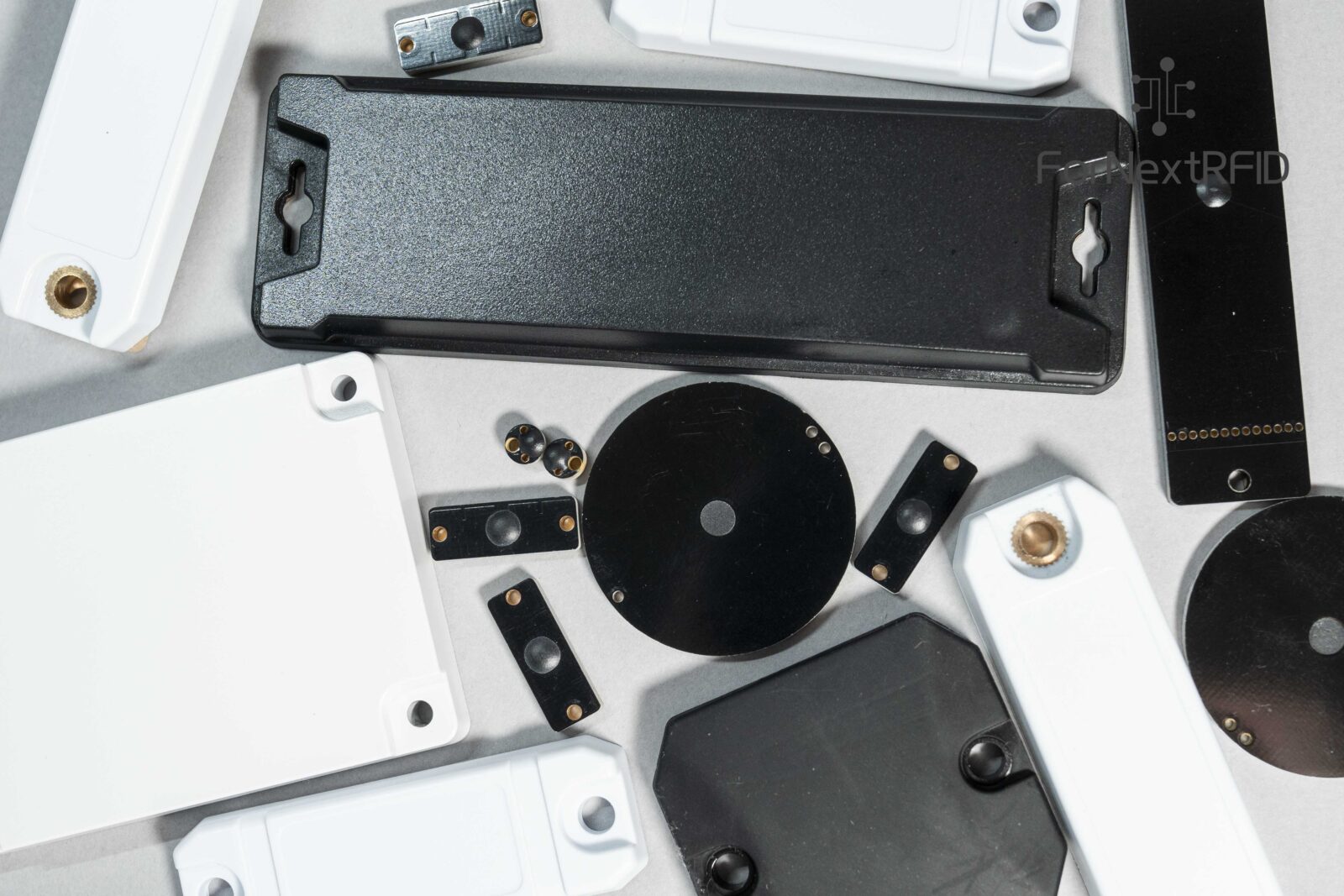
RFID label types and frequencies
RFID labels are usually based on one of three core technologies: HF, UHF or NFC. Understanding the differences helps you match the label to the environment and the reader infrastructure you already have or plan to install.
HF (High Frequency)
HF operates at 13.56 MHz and is widely used in smart cards, access control, ticketing and library systems. Typical read ranges are from a few centimetres up to around one metre, depending on the reader and antenna. HF generally tolerates liquids and nearby metal better than standard UHF inlays, which makes it useful for certain item-level applications in healthcare and libraries. Common standards include ISO/IEC 15693 and ISO/IEC 18000-3.
UHF (Ultra High Frequency)
UHF operates in the 860 to 960 MHz band. It is the workhorse technology for pallet and case tracking, retail inventory and fast conveyor or portal scanning. UHF supports long read ranges and high throughput, so it can capture large volumes of items with minimal human intervention. However, performance can drop near metal and liquids if you use general-purpose inlays, so on-metal and on-liquid variants are recommended where those surfaces are present.
NFC (Near Field Communication)
NFC also operates at 13.56 MHz but over very short ranges. It is optimised for smartphone and tablet interaction, contactless payments and product authentication. NFC works well when a user needs to tap an item with a phone to confirm service, access instructions or verify authenticity. It is not suitable for long-range or high-speed conveyor reading but is a good option for maintenance, field service and consumer engagement.
Special-purpose RFID labels: on-metal, on-liquid, laundry and tamper-evident
On-metal, on-liquid, laundry and tamper-evident labels are engineered to overcome specific environmental problems that standard tags struggle with. On-metal designs typically include a spacer or shielding layer so the antenna can radiate effectively on steel shelving, machinery or tools. On-liquid labels are shaped and tuned to cope with bottles and containers where the liquid would otherwise absorb the RF energy. Laundry tags use robust substrates and encapsulation to withstand industrial washing, drying and pressing. Tamper-evident labels employ fragile facestocks or security cuts so that attempts to peel or move them leave visible damage and, in some cases, break the antenna.
RFID label comparison
| Type | Frequency range | Typical use cases | Advantages | Key considerations |
|---|---|---|---|---|
| HF (High Frequency) | 13.56 MHz | Access control, ticketing, library systems, parts-level tracking near liquids | Performs better near liquids than standard UHF, widely standardised, moderate read range | Shorter range than UHF, usually requires close placement of reader antennas |
| UHF (Ultra High Frequency) | 860–960 MHz | Pallet and case tracking, retail inventory, loading bay portals, conveyor systems | Long read range, fast bulk reads, high throughput for supply chains | Sensitive to metal and liquids without specialist tags, requires region-specific tuning and good tag positioning |
| NFC (Near Field Communication) | 13.56 MHz (very short range) | Mobile payments, consumer engagement, product authentication, close-range scans | Native smartphone support, easy user interaction, secure short-distance reads | Very short read distance, not suitable for portals or conveyor applications |
| Special-purpose labels (on-metal, on-liquid, laundry, tamper-evident) | HF or UHF depending on design | Metal racks and tools, containers with liquids, rental textiles, sealed samples and kits | Optimised for challenging surfaces and environments, improved reliability in harsh conditions | Higher unit cost than generic labels, selection needs to match a specific application and test results |
How to choose the right RFID label
A structured selection process reduces read errors and avoids wasted spend on unsuitable labels.
Define the surface and environment
Identify where the label will be applied: bare metal, painted metal, cardboard, plastic, glass, textiles or mixed packaging. Note any exposure to liquids, chemicals, dust, high temperature, industrial washing or outdoor conditions. Use on-metal, on-liquid or laundry-rated labels where appropriate.Set read range and movement requirements
Decide how far away you need to read the tag and how items will move. Fixed portals and conveyors usually favour UHF for long-range and bulk reading. Close-range checks, service confirmation and consumer interaction can often use HF or NFC.Check reader infrastructure and standards
Confirm which frequencies and protocols your existing readers support and ensure that chosen labels are compatible with regional regulations. Consider whether you will use handheld readers, fixed readers, smartphones or a mix.Consider label size, placement and attachment
Larger UHF inlays often provide longer read ranges, but you may be constrained by product packaging or available surface. Plan where labels will be placed and how they will be attached (adhesive, rivets, sewing into textiles) and check that placement is practical for operators.Plan for durability and lifecycle
Match the label construction to the expected lifecycle. Laundry applications require tags that survive many wash cycles, while outdoor or industrial uses may need resistance to UV, vibration and impact. Tamper-evident labels are essential where chain of custody is critical.Pilot in real operating conditions
Before full rollout, test a small batch of candidate labels in the live environment. Run them through portals, conveyors or service workflows and measure read reliability at real distances and speeds. Live tests reveal detuning, reflections and handling issues that lab tests may miss.
Industry applications of RFID labels
RFID labels transform how organisations track items and identify assets by capturing data automatically and reducing human error. Different industries favour different combinations of frequencies and label constructions.
Warehousing and logistics
In warehouses and distribution centres, UHF labels are typically used for pallet, case and item-level tracking because they support portal reads and fast conveyor scanning. On-metal labels are useful for racks, trolleys, cages and metal containers where standard labels lose performance. For liquid-heavy environments such as beverage or chemical distribution, on-liquid tags help maintain read rates on bottles and drums. A short warehouse pilot can validate which inlay sizes, positions and attachment methods achieve consistent reads at dock doors and marshalling areas.
Manufacturing and heavy industry
Manufacturers tag tools, moulds, components and work-in-progress to avoid downtime and misbuilds. On-metal labels that can be fixed to machinery, jigs and metal totes are common. Harsh environments demand robust constructions that tolerate vibration, oil, dust and temperature swings. Regular testing and inspection of labels should be part of maintenance routines to keep read performance stable over time.
Healthcare and pharmaceuticals
In healthcare, HF and UHF labels track high-value equipment, surgical kits, specimen trays and medical assets. Tamper-evident labels protect chain of custody for samples, sealed kits and drugs, making it obvious if a package has been opened. On-liquid variants help monitor IV bags and biological containers, where liquid would otherwise interfere with the RF field. Compliance and patient safety requirements mean that label selection and testing must be carefully documented.
Retail and apparel
Retailers use UHF labels to accelerate stock counts and support omnichannel fulfilment by improving inventory accuracy. For rental textiles and workwear, laundry-rated tags survive repeated industrial washes and pressing. NFC labels can provide consumer engagement at the point of sale or in-store, such as linking to authenticity checks, care instructions or marketing content via a smartphone tap.
Field service and IT asset management
Field service teams and IT departments use RFID labels to improve maintenance and asset tracking. UHF or HF labels on servers, laptops, network equipment and field devices provide accurate asset histories and locations. Technicians can scan tags with handheld readers or smartphones (for NFC/HF) to access service records, confirm inspections and reduce paperwork. This improves service times and equipment uptime.
For technical guidance and deployment examples, consult trusted resources such as RFID Journal and Identiv, which publish standards, test methods and case studies from different sectors.
Related terms you may encounter
You may see several related terms used alongside RFID labels:
RFID tags / RFID transponders – general terms for devices that respond to an RFID reader, including labels, hard tags and cards.
UHF labels – RFID labels based on UHF technology, commonly used in logistics and retail.
HF stickers – HF-based labels supplied on a liner, often used as access-control or library stickers.
NFC tags – short-range HF tags optimised for smartphone interaction.
Asset tracking / inventory management – software and processes that use RFID and other data capture tools to locate and manage items.
Working with ForNext RFID on label selection
ForNext RFID supports UK and European organisations through the full RFID label selection process. The product range covers on-metal, on-liquid, laundry and tamper-evident tags, as well as HF, UHF and NFC labels suitable for industrial and commercial use.
The technical team can recommend candidate inlays for your surfaces, supply sample sets for trials and help design simple test plans for portals, handhelds and smartphone-based workflows. They work with your system integrator or in-house team to balance performance, durability and budget.
To discuss a project or request sample labels, contact ForNext RFID or email sales@fornextrfid.co.uk. Working from real pilot results and expert input helps you move from small trials to stable, scalable deployments with fewer surprises in the field.
Frequently Asked Questions (FAQs)
What are the main types of RFID labels and when should I use each?
HF labels run at 13.56 MHz and work well for access control, parts-level tracking and near-liquid items.
UHF labels cover 860–960 MHz and suit pallet, case and dock scanning because they read at longer ranges.
NFC is a close-range form of HF and works with smartphones for consumer engagement and authentication.
Special-purpose labels such as on-metal, on-liquid, laundry and tamper-evident adapt antenna and material choices for harsh conditions.
How do environmental factors influence label selection?
Metal and liquid environments can detune normal labels, so choose on-metal or on-liquid variants.
High temperatures and chemicals require laundry-rated or rugged labels because they resist degradation.
Therefore test labels on actual assets and surfaces to confirm reliable reads in the field.
Can smartphones read RFID labels?
Most smartphones read NFC tags because they use the HF standard.
However smartphones cannot read standard UHF labels without special hardware adapters.
For a clear comparison of NFC, HF and UHF capabilities see this link.
What steps should I take to test RFID labels before rollout?
Start with a small pilot that mirrors the final environment.
Measure read distances, angles and throughput with target readers and antennas.
Also validate attachment methods, adhesives and lifecycle resistance under typical conditions.
For practical testing guides visit this link.
How do I choose a reliable supplier and which certifications matter?
Pick a supplier with proven experience in on-metal, on-liquid and laundry tags.
Moreover check for quality controls and industry certifications to ensure performance.
ForNext RFID offers product ranges, technical support and certification documentation at their website, and they can help with sample testing and pilot planning.

