

Choosing the Right RFID Label
Choosing the right RFID label is critical for accurate tracking, inventory control and asset protection. Different materials and environments affect RF performance, so on-metal, on-liquid and laundry tags behave very differently. If you choose the wrong tag type, you can see missed reads, “ghost” stock, lost items and higher operating costs across supply chains and service operations.
This guide compares on-metal, on-liquid and laundry RFID tags, and shows how antenna tuning, substrates, mounting methods and environmental conditions affect read reliability. It gives practical recommendations for asset tracking, industrial maintenance, medical applications and textile care so that procurement teams, system integrators and engineers can select tags that deliver high read rates, long service life and lower total cost of ownership.
You will also find short case-style examples, lab testing tips and bill-of-materials guidance to shorten deployment times. Finally, we highlight relevant standards, cleanliness and chemical resistance requirements, and compliance considerations that influence tag choice and lifecycle cost in regulated sectors such as healthcare, food, pharmaceuticals and industrial services.
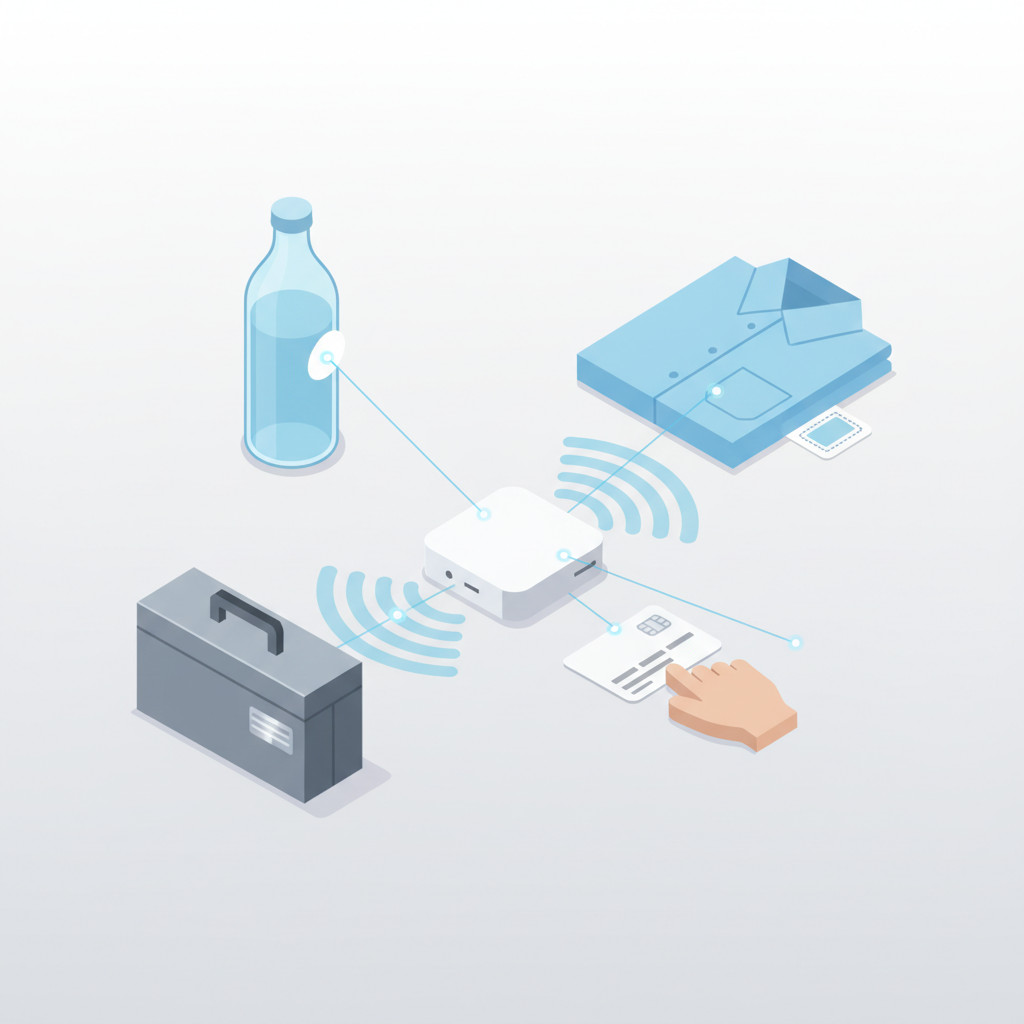
How an RFID Label Works
An RFID label is a small wireless device that stores and transmits data using radio waves. To work reliably, it relies on three core components and the surrounding infrastructure:
Chip (IC): Stores a unique identifier and small data blocks, and defines security features and memory layout.
Antenna: Captures and reflects RF energy to power the chip and return a signal to the reader. Geometry and tuning are critical to performance on metal, liquids or textiles.
Reader: Sends interrogation signals, receives replies and applies filtering logic such as EPC reads, RSSI thresholds and anti-collision algorithms.
Middleware and software: Collects tag reads, filters noise, applies business rules and integrates with WMS, ERP, MES or other databases.
Different frequency bands, such as UHF (860–960 MHz) for long-range and bulk reading or HF/NFC (13.56 MHz) for short-range secure transactions, change read range, penetration and antenna design. Understanding these basics makes it easier to match label type, frequency and construction to your environment and application.
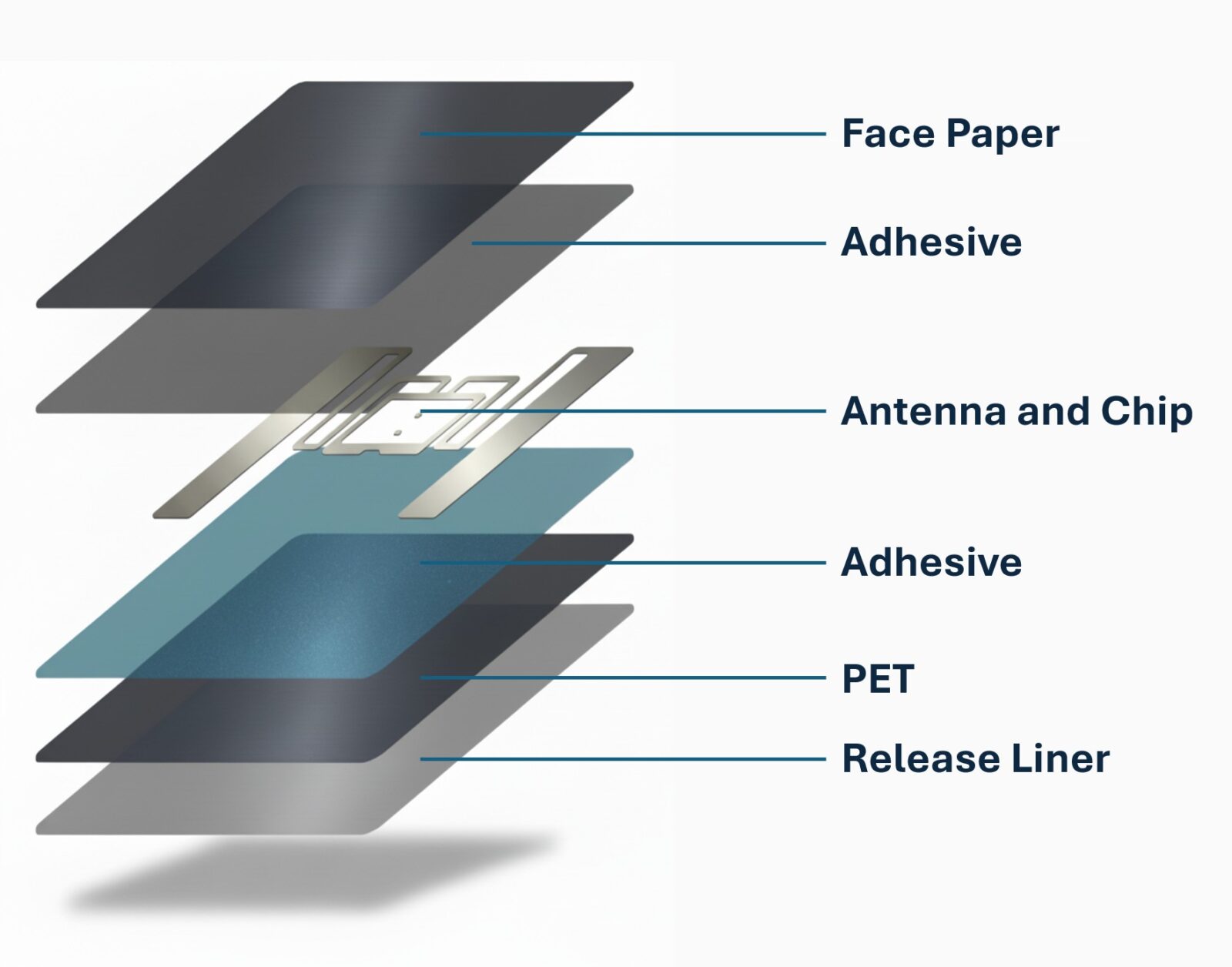
For a deeper technical primer, see specialist resources such as RFID Journal.
Why Material and Environment Matter
The same RFID tag behaves differently on a steel toolbox, a bottle of liquid and a cotton shirt. Three factors drive most performance differences:
Substrate interaction
Metal surfaces detune standard UHF antennas and can absorb or reflect RF energy in ways that prevent a stable read.
Liquids (especially water-based products) absorb RF energy and reduce read range or cause dead spots.
Textiles fold, flex and compress, which can change tag orientation and distance to the reader.
Environment and process
Industrial sites expose tags to impact, vibration, oils and temperature extremes.
Hospitals, laundries and food plants combine chemicals, detergents, steam and repeated washing or sterilisation.
Outdoor assets must handle UV, moisture cycles and freeze–thaw conditions.
Mounting and orientation
Adhesives and mechanical fixings must suit the surface and operating temperature.
Poor placement and random orientation reduce read reliability, even with a good tag design.
Dense stacking, metal shelving and liquids in close proximity can create shadowing and interference.
Choosing the right RFID label type and construction is therefore a technical decision, not just a purchasing one.
Comparing On-Metal, On-Liquid and Laundry RFID Tags
The table below focuses on the three main challenging use cases discussed in this guide. It is intended to support practical label selection rather than provide a generic HF/UHF/NFC overview.
| Label type | Substrate & mounting | Typical applications | Typical frequency | Durability focus | Relative cost* |
|---|---|---|---|---|---|
| On-metal label | Metal surfaces, bonded with high-performance adhesive or mechanical fixing, usually with a spacer or ground plane to prevent detuning. | IT assets, tools, tanks, metal totes, industrial fixtures. | UHF 860–960 MHz (EPC Gen2). | IP67–IP68 options, extended temperature range, impact resistance. | Mid to high, depending on ruggedisation. |
| On-liquid / liquid-stable label | Applied directly to bottles, vials or containers near liquids, often with specialised antenna geometries and face materials. | Beverages, pharma vials, lab samples, chemical containers. | UHF 860–960 MHz. | Resistance to moisture, condensation, chemicals and cold-chain handling. | Higher than standard labels due to complex antenna design. |
| Laundry / textile tag | Sewn into hems, pouches or labels, or attached using heat-seal or adhesive, designed to flex with fabric. | Hospital linens, hospitality textiles, uniforms, rental textiles. | UHF 860–960 MHz or HF 13.56 MHz. | Multiple wash and dry cycles, detergents, pressing and tunnel finishing. | Moderate per unit, low lifetime cost with high cycle count. |
*Relative cost is indicative and depends on volume, customisation and certification requirements.
When to Use On-Metal RFID Labels
On-metal RFID labels are engineered to perform reliably when applied directly to conductive surfaces. Typical features include a tuned ground plane, foam or polymer spacer and metal-optimised antenna layout.
Use on-metal labels when:
The asset has a significant metal surface, such as servers, racks, tools, gas cylinders, industrial tanks or metal pallets.
You need consistent read ranges in dense metal environments such as workshops, maintenance stores or data centres.
You want a relatively low-profile format compared with bulky hard tags, but with enough protection for handling and cleaning.
Key design considerations:
Spacer thickness: A thicker spacer generally improves performance on metal, but may increase cost and profile height.
Adhesive and bonding: The adhesive must suit the metal type, surface finish and temperature range. Mechanical mounting may be required for rough or oily surfaces.
Operating temperature: Check the specified range for use near ovens, freezers, outdoor installations or engine compartments.
Read range vs size: Larger labels typically offer longer read range, but may not be suitable for very small tools or constrained mounting locations.
When to Use On-Liquid and Liquid-Stable RFID Labels
Standard UHF labels placed directly on bottles, vials or containers of liquid often show reduced read range or inconsistent performance. On-liquid or liquid-stable RFID labels mitigate this using specialised antenna designs and face materials.
Use liquid-stable labels when:
You need to track beverages, chemicals or pharmaceuticals in bottles, vials, IV bags or sample tubes.
Items travel through automated filling, packing and palletising processes where fast bulk reading is required.
You need reliable reading in cold-chain conditions, near condensation and in densely packed boxes or trays.
Key design considerations:
Container type and fill level: Clear glass, plastic and metalised packaging behave differently. Performance can change as containers are filled, partially used or empty.
Orientation in trays or cartons: Label placement on the neck, shoulder or body of the container affects read reliability in tunnels or gate readers.
Chemical and temperature resistance: Face materials and adhesives must tolerate solvents, cleaning agents and storage temperatures.
Regulatory and labelling rules: In pharma and food, labels must meet printability, legibility and materials requirements for direct or indirect contact.
When to Use Laundry RFID Tags
Laundry and textile RFID tags are built to survive repeated washing, drying and finishing processes while remaining comfortable and unobtrusive in garments and linens.
Use laundry tags when:
You manage hospital, hotel, workwear or rental textiles and need item-level visibility.
You want to reduce loss, miscounts and manual sorting in laundries and depots.
You operate high-throughput tunnel washers, presses and folders where tags face mechanical and thermal stress.
Key design considerations:
Mounting method: Sewn-in pockets, hems, patches and heat-seal labels each offer different trade-offs for comfort, security and handling.
Cycle life: Specify the required number of wash and dry cycles, plus temperature range for washing, drying and ironing. Many industrial tags target 50 or more cycles.
Chemicals and detergents: Check resistance to alkali detergents, disinfectants and bleaching agents used in healthcare and industrial laundries.
Reader layout: Plan antennas in chutes, conveyor lines and sorting areas so tags are reliably read in bulk while moving and overlapping.
Practical Testing and Deployment Tips
Before committing to a large deployment, it is important to validate the RFID label design in your real environment:
Pilot in the actual process: Test on the real assets, racks, containers, machines and textiles, not only in a lab.
Mix different orientations: Include worst-case orientations and stacking patterns in trials to expose weak spots.
Measure read rates, not just range: Aim for consistent high read percentages across process steps rather than maximum distance in open air.
Track failure modes: Record any tag damage, adhesive failures or detuning caused by cleaning, handling or storage.
Review bill of materials: Confirm chip type, antenna design, substrate, adhesive and encapsulation. Small changes can impact performance and cost.
Working with an experienced manufacturer helps you adjust the design, choose the right inlay and encapsulation, and avoid costly redesigns later in the project.
ForNext RFID Manufacturing Capabilities and Product Portfolio
ForNext RFID brings over 18 years of manufacturing experience to RFID label and smart card production. The company operates certified production lines with inline testing so that each roll or batch is checked for electrical performance, encoding quality and visual defects. Tight process control reduces field failures and improves read reliability in complex environments.
Capabilities include:
High-volume roll-to-roll inlay production with custom antenna tuning.
Lamination and rugged encapsulation for on-metal and industrial labels.
Chip programming, secure encoding and serialisation at scale.
Custom printing, including logos, variable text and barcodes.
Support for HF, UHF and NFC formats across labels, hard tags and smart cards.
Key product groups include:
UHF on-metal labels and hard tags for asset tracking, tools and industrial equipment.
On-liquid and liquid-stable labels for beverages, pharmaceuticals and laboratory samples.
Laundry and textile tags designed for repeated wash, dry and finishing cycles.
NFC contactless smart cards and HF inlays for access control, ticketing and payment-related applications.
ForNext partners with major chip vendors and supports EPC Gen2 and relevant ISO standards to ensure interoperability with common readers and software. For background on chip ecosystems, see vendor documentation such as NXP resources. For detailed standards information, RFID Journal and standards bodies provide further reading.
By combining manufacturing scale, certification and ecosystem partnerships, ForNext delivers RFID solutions suited to logistics, healthcare, retail, industrial services and other demanding sectors. For custom designs, samples and volume pricing, contact sales@fornextrfid.co.uk.
Conclusion
Selecting the right RFID label for metal, liquids and textiles is essential if you want high read reliability and predictable lifecycle cost. Matching antenna design, substrates, encapsulation and mounting to your environment prevents misreads and early failures.
ForNext RFID brings engineering and production experience across HF, UHF and NFC products. Its manufacturing lines support roll-to-roll inlays, lamination, rugged encapsulation, chip programming, secure encoding and custom printing for projects at scale. Quality controls and industry certifications help ensure consistent read performance in harsh or regulated environments, which reduces replacement rates and total cost of ownership.
Supported standards such as EPC Gen2 and ISO-based protocols provide interoperability with common readers, portals and software platforms. Combined with technical support and, where required, on-site consultation, this allows project teams to accelerate deployment and avoid expensive redesigns.
To explore product options, request datasheets and organise testing support, contact ForNext RFID at sales@fornextrfid.co.uk.
Frequently Asked Questions (FAQs)
What is RFID and how does it work?
RFID uses radio waves to identify items wirelessly. A tag, antenna and reader exchange signals. As a result, systems capture IDs quickly without line of sight.
Which tag type is best for metal, liquids, or textiles?
On-metal labels suit metal assets; liquid-stable tags work near fluids; laundry tags endure repeated washes. Therefore, choose by environment and required read range.
Can ForNext supply custom tags and programming?
Yes. ForNext offers custom antenna tuning, chip programming and encoding at scale. Moreover, they support HF, UHF and NFC formats with quality testing.
How durable are laundry and on-metal tags?
Durability varies by design, but many laundry tags survive 50+ washes. On-metal tags often meet IP67 or IP68 and withstand extreme temperatures.
How do I request samples or support?
Contact ForNext via their website or email sales@fornextrfid.co.uk. They provide datasheets, samples and testing support to speed pilots and deployments.

