

For many warehouses, retailers and laundries the choice between barcodes and RFID now affects daily operations. Both identify items, but they differ in how quickly they capture data, how much manual work they require and how far you can automate stock counts and tracking.
This article compares barcodes and RFID in practical terms so you can see where each fits best and where item level RFID can realistically add value.
Why Item Identification Matters
Effective stock control depends on three basic questions: what products you have, how many of each you hold and where individual items are located. Barcodes work well for the first two points, but struggle with precise item level visibility. Staff must see and scan each label, which is slow and easy to interrupt.
RFID was developed to reduce this manual work. It uses radio signals to identify many items at once, without needing line of sight, and can report both product type and a unique ID for each tagged item.
How Barcodes Work
Barcodes are printed patterns of lines or squares that represent numbers and characters. When a scanner or camera reads the symbol, your POS or WMS looks up the product description, price and other data in a database.
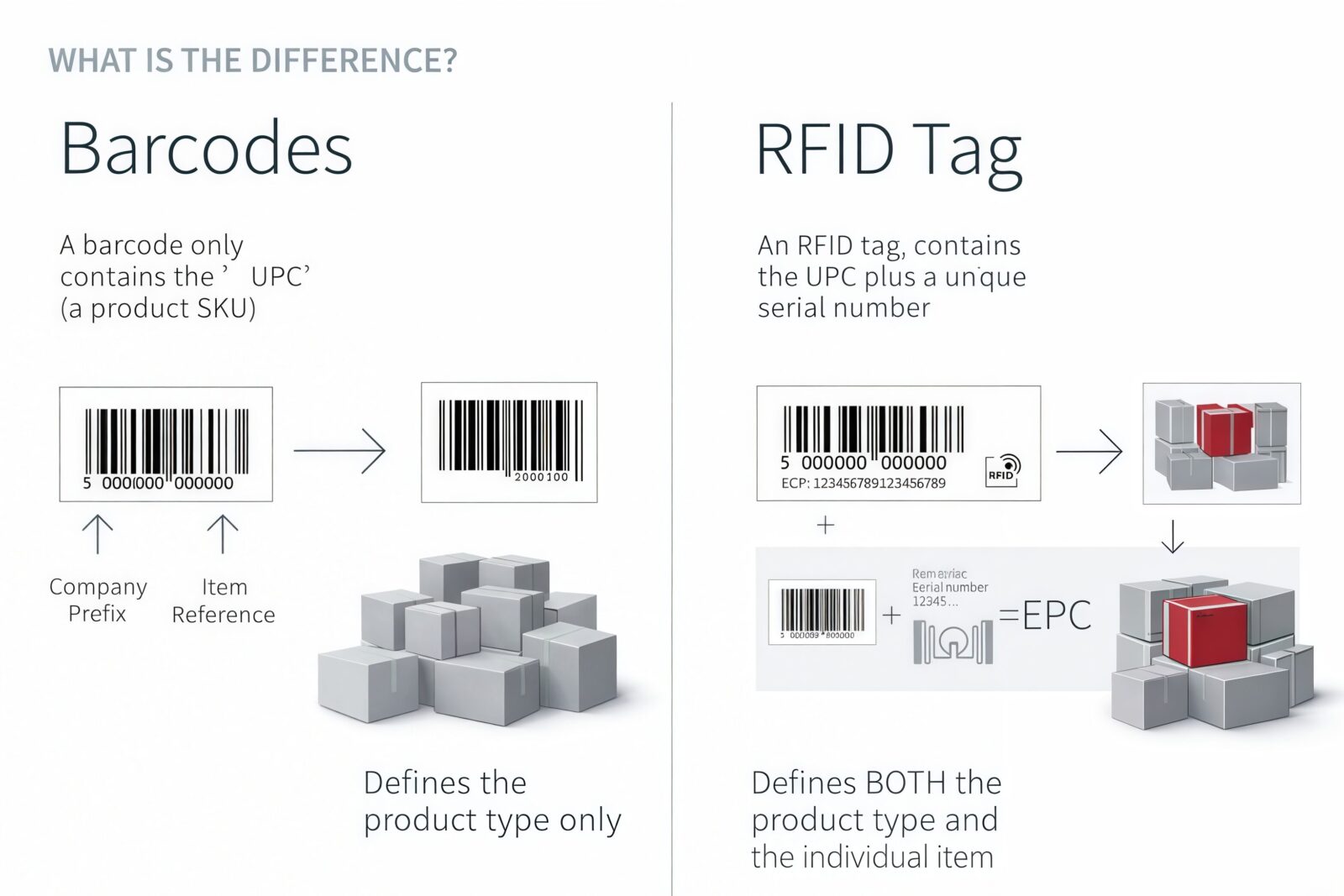
Most one dimensional barcodes, such as EAN or UPC, encode a product code or SKU rather than the unique identity of each item. Two dimensional barcodes, such as QR or Data Matrix, can store more data but they are still optically read images that must be clearly visible.
Barcodes are cheap to print on labels, packaging or documents. The trade off is that operators usually scan items one by one, or in small groups if labels are positioned well. This is acceptable where volumes are moderate, labour is available and you do not need to distinguish between individual units.
How RFID Works
RFID tags contain a small microchip with memory, an antenna and some form of carrier such as a label, hard tag or card. In UHF RFID systems used in logistics, each tag typically stores a product identifier plus a unique serial number or EPC that distinguishes every single item.
An RFID reader sends out a radio signal, which powers nearby tags and prompts them to reply with their data. In a well designed read zone dozens or hundreds of tags can be captured in a fraction of a second, without needing to see them. Items can be inside boxes, on hangers or moving on a conveyor and still be read.
This enables true item level visibility. You do not just know that fifty size medium red dresses are in stock, you know which fifty individual dresses are in a specific location.
Barcode vs RFID: Key Differences
Both technologies support product identification, but with different characteristics.
Barcodes store a product code and rely on a database for all other information. They require line of sight and careful aiming, and read range is usually limited to a few centimetres or up to about a metre. Label cost is very low and equipment is inexpensive.
RFID tags can hold both a product code and a unique item ID. They are read by radio rather than optics, so line of sight is not required and read range can extend to several metres depending on the setup. Tag and infrastructure costs are higher, but specialist tags can be very robust and there are stronger options for anti counterfeiting and access control.
Costs and Integration
Barcodes have very low entry cost. You need printed labels and simple scanners, and most systems accept barcode data as basic keyboard input. For many smaller operations this remains the most practical solution.
RFID requires a higher initial investment. Tags cost more than printed labels, and you need readers, antennas and some form of middleware or integration with your WMS or ERP. In return, RFID can reduce staff time for stock counts and receiving, cut shrinkage and loss of assets, and improve on shelf availability. For higher value goods or labour intensive processes these savings can outweigh the extra cost.
Integration work usually involves defining tag placement and label materials, configuring handheld or fixed readers, mapping EPCs to your existing item master data and adjusting processes to exploit automated reads.
Choosing What Fits Your Operation
Barcodes are usually sufficient where items are low value, stock movements are simple and manual scanning does not block throughput. Small stores, workshops and spare parts rooms often fall into this category, especially where labels will be damaged quickly and individual item identity is not critical.
RFID adds clear value when you need fast, regular cycle counts without closing areas, when you must track individual garments, tools, assets or laundry pieces, or where labour for manual counts is expensive. It is also useful when you need to locate a specific item quickly, such as a particular jacket in a store or an asset somewhere in a building.
Most organisations that adopt RFID do so gradually. A common approach is to run a pilot in one store, one warehouse zone or one product category, prove the business case, then extend tagging and automate additional steps. A specialist supplier such as ForNext RFID can help select suitable tags, test read performance on your own products and plan a realistic roadmap from barcode only to combined barcode and RFID workflows.
In simple terms, a barcode tells you what the product is at the moment you scan it. RFID can tell you which exact item it is and where it is, often without manual scanning. The right mix depends on your volumes, labour costs and how much value you place on accurate, item level visibility in your business.

